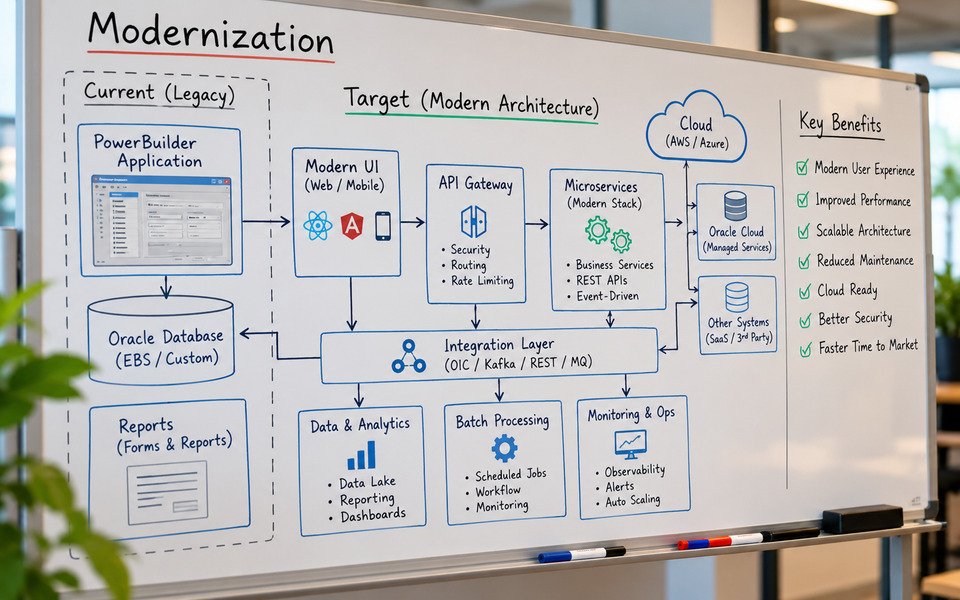
A modernization project almost never fails at go-live. It fails eleven months later, when the team that built it has moved on, the documentation is thin, and every quarterly update becomes a small crisis.
The pattern is familiar. A company invests in modernizing a core system, moving off a legacy platform, replatforming to the cloud, or implementing a new ERP. The launch goes well. Then ownership quietly disappears. The implementation partner's contract ends. Internal teams inherit a system they didn't build and don't fully understand. Enhancement requests pile up. Nobody validates the next quarterly release until something breaks.
This isn't a technology problem. It's an operating model problem. Modernization is treated as a project with a start and an end, when the systems themselves keep changing indefinitely, through vendor updates, new integrations, and shifting business needs.
The fix is straightforward but requires discipline: define who owns the system after go-live before go-live happens. That means a clear answer to who validates each quarterly update, who triages enhancement requests, who owns the integration layer, and who has the authority to say 'not yet' when a change looks risky.
In our experience, this is best served by a small, accountable team with senior technical involvement, not a rotating queue of tickets. Continuity matters more than headcount. A team that has carried a system through three release cycles will catch problems that a fresh team, however skilled, will miss the first time.
Modernization isn't a project you finish. It's a capability you build. Treat it that way from day one, and the eleven-month crisis becomes far less likely.